Jason A. Belt

Coalesce – come together to form one mass or whole.

  • I’m a dad, husband, friend, and son
  • I am a nerd and I love sports
  • I love learning about new things
  • I am fueled by solving problems with people and building teams
  • As a former baseball player. there is nothing compared to the feeling of hitting a Home Run.

    I will do my best to describe the feeling below:

    • Fear, excitement, anxiety, wonder, and focus as I step into the batter’s box.
    • Anticipation of the pitch being delivered as the pitcher starts his delivery.
    • Analysis in the moment as the hand is exposed during the delivery… how is his hand positioned… palm facing me? Yes! probably straight.. probably a fastball…
    • Slight exhale as the ball is released from the pitcher’s hand.
    • The excitement in a millisecond as you realize this pitch is in your zone.
    • My eyes wide, halted breathing, my brain is smiling… (I know, hard to describe…)
    • My body explodes propelling my hands to the ball in an instant guided by 1000s of repetitions before.
    • The bat follows your body and makes contact with the ball moving in the opposite direction.
    • I feel weightlessness, no resistance, but my hands subtly register the ball making contact with the bat.
    • Perfection.
    • A loud crack, that is unique but all too familiar.
    • Exhilaration for a split second as I watch the ball fly off the bat before running.
    • The sprint to first is stopped with the confirmation the ball left the yard.
    • Then I trot and feel powerful.
    • Humility sets in as I round third seeing my teammates happier than me, which then turns to thankfulness for being there with them.
    • A bit of sadness sets in for just a brief moment as I relish this fleeting moment. I know how rare this moment is.
    • Satisfaction sets in as I’m escorted back to the dugout by my teammates.
    • All of us happy.

    I tried my best to describe how it felt to hit a home run, and it truly is indescribable, but I did my best.

    As good as that feeling was, I found much more success playing the game by making contact consistently, and hitting base hits. I worked hard at this craft. I took 1000s of swings year after year in practice to be the best I could be at hitting a round ball flying at me, with a round bat.

    I love the game. The uncommon difficulty, and even the failure.

    Business is much like this. If you push yourself, have great teammates, and are driving toward a common goal, then you can hit home runs and feel a similar feeling together.

    My challenge to you and the teams you work with would be:

    • Place more value on the base hits.

    In baseball, base hits are truly the lifeblood of any winning team: Base runners to then score by other base hits.

    Base hits are progress. In business, base hits are the new process you are trying to improve service performance, but instead of waiting for the perfect policy, workflow, and tooling, you roll out a simple checklist and gain some movement in the right direction. Base hit.

    This enables the team to offer feedback around this process to improve it and then move the improvement forward. Base hit number 2. The team sees results and one more tweak to improve further. Base hit.

    The team scores when the client and internal teams see the progress and everyone is better off, especially the customer.

    Run scores!

    As good as it feels to hit a home run, it is rare, and solo, whereas a base hit is more common and can lead to others hitting one too, leading to a team score. More importantly, in business, progress toward the goal sooner.

    I am fortunate to have a Dad that was always there for me, practiced with me whenever I wanted, and went to all of my games. He captured me hitting a home run in this video, so you can see the description above in action. I love hearing his commentary as I watch the memory. Thanks, Dad.

  • If you are like me, you have many inputs and outputs to manage, and sometimes between the texts, emails, instant messages, and phone calls, it is tough to make sure that nothing is missed.

    This is where the checklist could help.

    It is a simple thing and people have been writing things down for 100s of years. Making a list, checking it twice… So, even Santa has used a checklist, and what is more important than ensuring each kiddo in the world gets a gift from Santa?

    Sometimes jobs are centered around one really large program, so then the checklist would be a single thread of tasks around the single program to ensure completion. Sometimes the checklist may be for a single day to be trashed and then the next day has a checklist all to its own. In other jobs, the checklist is what ensures a very complex and even life-saving process is followed to the letter.

    In the book, Checklist Manifesto by Atul Gawande, the author makes the case for and how to use checklists. He takes you on a journey through fields that truly rely on this simple but effective tool to ensure things get done. Here is a great summary of the book: Summary by Graham Mann.

    My job currently has many large projects converging at the same time, so I use a punch list that is organized by top-line subjects and then the days subtasks associated with the top-line subject. The daily checklist for each is then changed as the project or process change is moved further to completion. Also, I use a KanBan project planning app that has cards and then inside the cards, there are checklists of specific items to close that part of the project.

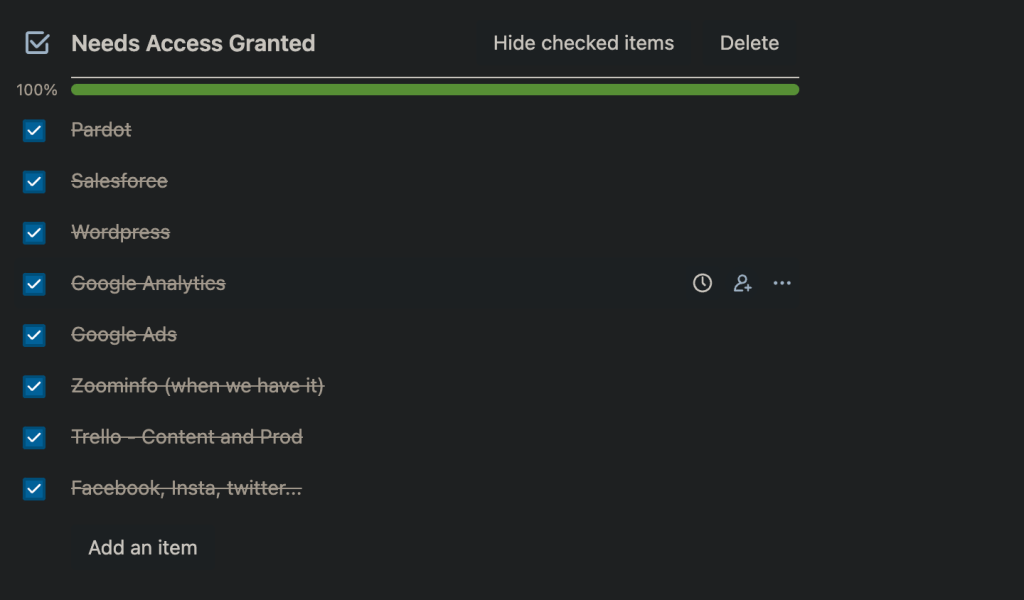
    Here’s how I organize my checklists by top-level headings:

    In this image below, the top-level heading is what my team is trying to accomplish and in this case, we were ensuring that all the items from the Element Three marketing onboarding were completed. Check out E3’s website in the link and if you need some great marketing wisdom, reach out to Dustin. He is the man!

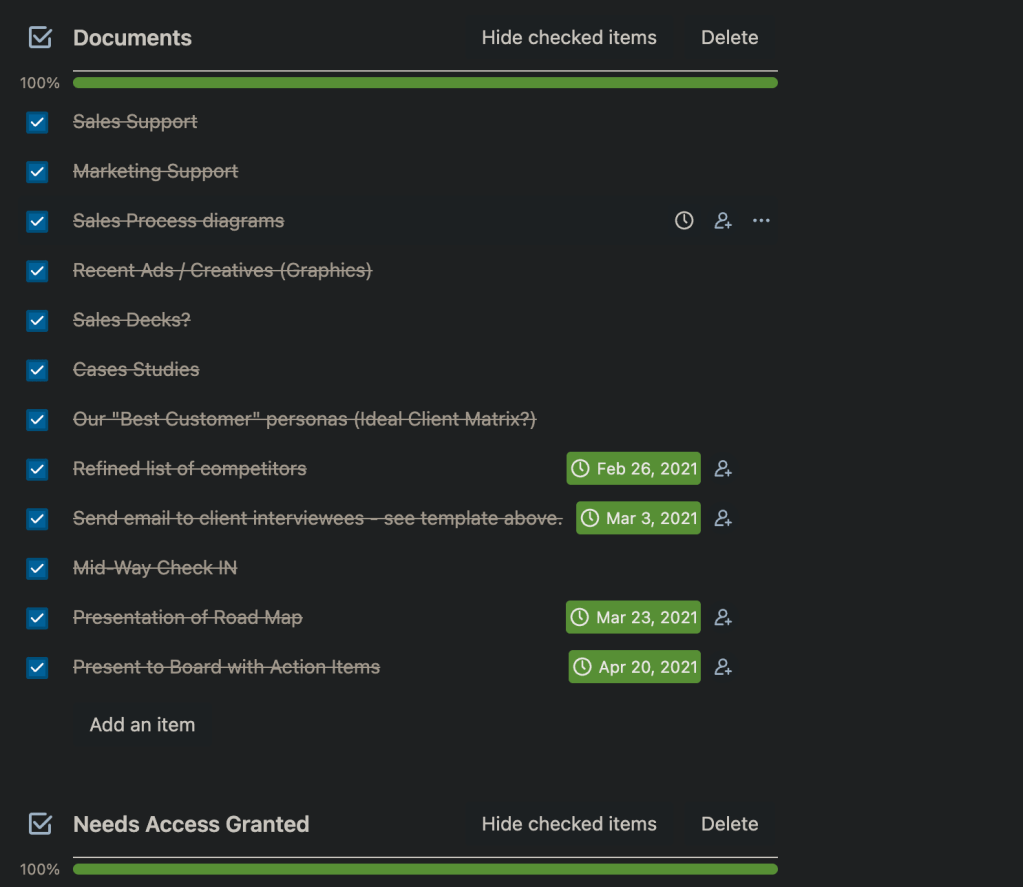
    Now, In this image below, you can see the first top-level header and subtasks making up the checklist for each item. The best part about using an app like the one you see in the image is that you can openly collaborate with a team and move faster together off of one checklist.

    Using an app like this also enables multiple checklists in one Card or group as pictured below. We had two parts to this onboarding documents and access deliverable and we were able to track the checklist for both parts on this shared app.

    I know, seems like common sense, but many people and companies do not use the power of a collaborative checklist. So, having a checklist habit for yourself, and then expanding that by using an app to make and work from a shared checklist with your teams will drive up productivity and accuracy…

    Once you start using these, the peace of mind and clarity for all makes a major positive impact on the stress and anxiety levels of everyone on the team.

    With my teams, we use these kinds of checklists to drive meetings with a visual reference on what we are working on, so driving action with the shared list and creating focus in meetings add value to meetings as well.

    Lastly, there is a good feeling when checking off things at the end of the meeting or workday, and when looking back at all of the tasks that were completed when closing a project.

    I have found power in using checklists and I hope you will too.

  • Are you a fitness person?

    Do you wake up and workout first thing or are you an evening athlete that likes to watch Netflix and tread?

    It has been about 7 months since I started my new fitness habits and I have been much better for it. I follow a few fitness and health people I respect and above all else, I stick to my routines. After 20-25 days I was in a habit-forming pattern and then now, after 7 months or so, it has been about listing to my body as it feels weird not to workout, so if I need rest, I take an easy day. If I feel rested and ready to go, I go.

    I am a person that is all about making things easy, habit-based, part of a system, and in the end, if I feel better after, then it’s the best thing for me. Fitness and working out have become two of those things. So, keeping the routine is not only better for my health, but the best thing for my daily performance as a person.

    Historically I have left the fitness routine at home when I travel. Now, I have to make sure I keep up the routine for the consistency, feel, and daily benefit I get from the daily routine. Truthfully, I struggle at times to find a good place to workout when I’m traveling. I have traveled for work and for fun, but the same story plays out. It is definitely a fitness center grab bag each time I walk into the hotel. I stayed in one place where the hotel advertised having a fitness center, and when checking it out, the room was probably 12X12 with a tube TV and 2 machines and one of them being a tread from the 1990s, and a bald belt.

    Is the gym good? Will they have a good treadmill? Is the space large enough?

    Those are the questions popping into my brain as I consider places to stay when before that wasn’t even a consideration. I was more interested in the price, location, and king-sized bed. Well, I am old enough now to have a king-sized bed and a great fitness center to hit when I wake up!

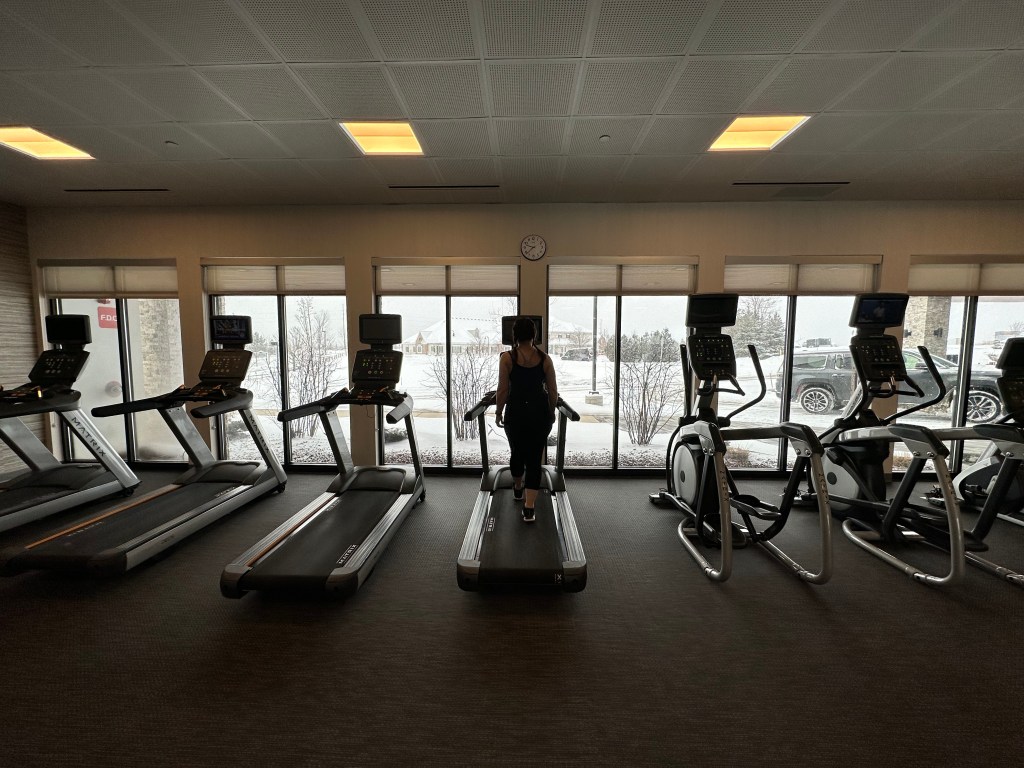
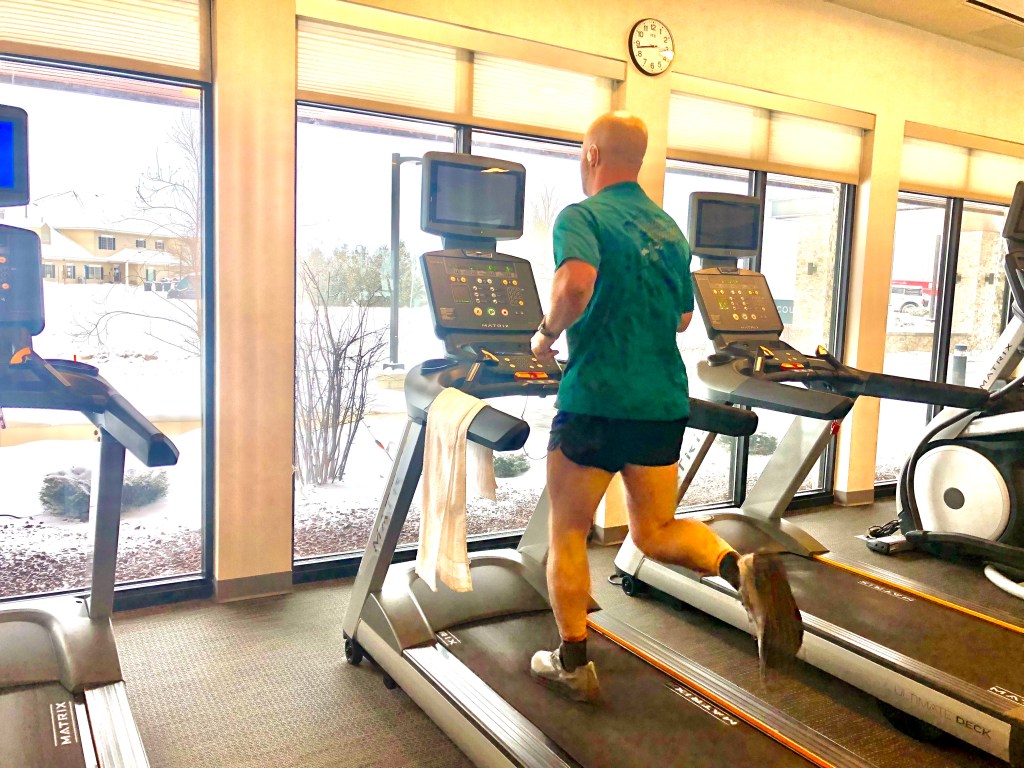
    During our last trip, my wife and I stayed at a new hotel in northern MI and it had one of the best gyms I have ever seen in a hotel. The tread was high quality and the weights and machines were top-notch. The space was flanked by a massive wall of windows.

    So, when I travel from now on, I am going to take the extra 5 minutes and call ahead and ask about the gym onsite.

    I love my fitness routine, so I think prioritizing the hotel price, bed size, with the gym quality is worth it.

    Do you workout when you travel?

  • My day job takes all of my brain power. I am plugged into it, completely focused on it. As we team out several shifts, changes, and improvement initiatives, I am totally working in that business.

    So, after I am done each weekday, or on the weekends, I found the best way to keep finding new ideas is to set a specific time(s) that is best for me to unplug and then plug my brain into reading, learning and writing down my thoughts about what I have learned. I like to apply what I have learned in my journal as I work out the day’s happenings and if it is the Saturday AM learning and writing block, I make larger notes that include plans, lists, and things I can use in my day job and in my personal life.

    In the evenings I love to read before bed. I try to read 1 chapter of a non-fiction book about a subject I am interested in. Then, it’s fiction! I love getting engrossed in a new world that is unlike my own and from the imagination of another person. In that way, my brain then gets some creative juices from another person, which is fun.

    Unplugging, learning new things, writing about them in my journal, and blogging plus other conversations help expand my brain around new ideas and in the end bring so much enjoyment and benefits to my life.

    Summary:

    • I spend alone time in the mornings and read a few key blogs and also follow a few research-based newsletters.
    • Block time on Saturday mornings when the family is asleep to read, think, and write.
    • I read a book for learning and a book for fun.
    • I try to put myself into my previous roles and think about what I would have done then knowing what I know now.
    • Write notes, lists, and plans applying my new learning.
    • Laugh at my mistakes and dream about what’s next.

    What are you going to read and write about?

  • I like to learn new things. I think learning new things is fun and keeps me on my toes personally and professionally. I started a routine several years ago where I would block out some time each morning and then a longer block on Saturdays for reading some blog posts, subscription emails, maybe a book, and then writing in a journal. This time has proven crucial for my growth and in the end, great for my mental health.

    So, I was thinking this week, ‘Why not share these new things I learn during my AM ritual?’

    Well, here is the first one!

    “Don’t let the fear of discomfort be the thing that holds you back. Make friends with the Pain Cave, become familiar with yourself in there.”

    Josh Crosby, Trainer, Coach, and Apple Fitness Rowing

    I forgot to mention that I do work out first before anything else in the AM… This started about 3 weeks ago as I was having a hard time finding the mental fortitude to work out after a long workday.. so I moved the workout to the AM…

    Anyway – I was working out in the morning, on the rower, Apple Fitness queued on the TV in front of me, and Coach Josh was pushing me to row harder.

    Well, the rowing coach was telling me in a strong tone to move my rowing to another level and referenced the ‘pain cave’.

    As the sweat was pouring, breathing labored, I was wondering.. what’s this pain cave thing he is referencing?

    So, after my workout was finished, I went to his website and found the quote above. That made me think more about what my pain cave would be. When was I the most challenged in my life, had to get comfortable with it, and then push through?

    Well, that’s easy!

    Being Stuck in the Grand Canyon during the R2R challenge last year. It is pitch black, nature coming alive around us, all you can see is the light of stars above showing the faint edge of the North Rim above with 3 miles and 1000s of feet in elevation more to go in the ascent, exhausted, demoralized from setbacks, 17 hours in, and unsure of how to get out except gritting through one switchback at a time.

    That is my pain cave. Well, the historical/physical embodiment of it.

    My Pain Cave…

    So, when I read the quote from Coach Josh’s website and considered the concept of making friends with the pain cave. I have been in the depths of the pain cave, but making friends with it? I could see the value in it as the coach was applying the meaning. When faced with that physical or mental barrier that you think is too much, then you can dig deep, but then even more important is the consideration of what that struggle is truly teaching you about who you really are.

    It made me think of how this applies professionally.

    We have all been through professional challenges. Bad bosses, toxic cultures, client crises, major changes, layoffs, outages of key tools, and loss of a critical person. When we are faced with these or other challenges, do we shirk away or do we dig deep? I have for the most part tried to dig deep, but did I really embrace the challenge? Did I look the pain in the eye and make friends with it? Did I truly take a humble approach and become familiar with myself in there or did I try to get out as soon as possible?

    I know the answer. I got out of there as soon as possible through quick action, teamwork, and or deciding to abort.

    I have conquered many challenges, but truly never considered the lessons learned from the moments when the struggle is real. I have always pushed through them asap and thought about lessons learned after the heat was off. I think this is normal, but from now on, whether on the rower, treadmill, or at work in the midst of a major challenge, I will be looking at who I am in the moment of struggle and I will be making friends with this version of me and asking… what else is holding me back and who am I really in this moment?

    I know that my pain cave, on the north rim, is pitch black, wondering how I got here and then realizing that I need to move and keep moving because that is who I am. Now when I am faced with any challenge, I think back to this pain cave and realize, I can conquer anything with enough time and perseverance. Looking back after learning from Coach Josh, I do wish I would have become friends with it and peered a little deeper, but when you are there, in the cave, it’s dark and sometimes you just need to respect it, understand it, and move.

  • How do we know what’s next? In Seth’s blog post here, he calls out a few methods of how people and organizations may set priorities. I have been in orgs that use the first in/first out, which I completely agree is lazy. I have also been in orgs where the squeaky wheel gets the grease so to speak. This method leads to what many people call firefighting. When everything is a fire, then nothing is, right? Setting priorities in an ever-changing business landscape is a hard task for any leader.

    Seems like this is what my brain visualizes when I am processing all the things that need to be done at times…

    Some of the ways I have found success in this effort are below:

    • Identify what you can control in the lifecycle of your product and become great at them.
    • Ask your customers what it would take to fire you, then make your processes and product rock solid in those areas.
    • Find areas where you have limited or no control. Worked harder, invest more, or build systems toward increasing influence or connections with others that can help with those areas.

    All three of these approaches can work together or be used alone. Each of them takes discipline, especially when moving from a firefighting culture to a planned and organized machine determined to execute and deliver. Each of these three take a commitment to relationships and candor with your teams and those you look to for help.

    In any org, stay the course and commit to making improvements each day and noting what you find for future fixes if you are not at a place where you have the capacity to act now. There is great power in a ‘parking lot’ of future ideas.

    Narrowing it down to the most important priorities?

    Hitting base hits on a few planned and targeted initiatives that you have the capacity to truly hone is much more impactful in the long term than trying to do too much too fast…

    Discipline to choose the priorities, then Execution and Adoption are what matters.

  • This was today’s session-specific Headspace quote. In the meditation lesson, the theme was centered around the mental grind that we try to pursue at times, but then the act of changing the environment, actions, or letting the mind drift a little oftentimes can produce a solution to the problem you are trying to grind out.

    So, taking a short walk, standing up from your desk and checking the weather outside, or perhaps pivoting to share a meme for a minute with a co-worker are good ways to find fresh ideas around problems you are otherwise faced with a blocker that may have seemed insurmountable.

    My mind has popped some of my best ideas or thoughts for work when I am working out, meditating, and even when doing other things like at the grocery. I am walking down the aisle and pop! my brain gives me a quick idea about something unrelated that I can use to further my aim in that goal.

    I love this visual and I find that if I allow my thoughts to come and go, and as mindfulness practice helps you in acknowledging the thought and then releasing it, it is your choice to use the thought and or let it float away.

    As I have shared, I use the app Headspace for guided meditation and mindfulness practice. I love it for the way it makes the practice of mindfulness easy to understand and engage with for an ‘A-Type’ like me. During and after lessons the quotes I have shared here pop up in the app before and after sessions along with daily lessons with videos.

    I used to think that meditation and mindfulness were a gimmick and that we needed to be gritty people and that being gritty was stand-alone. After practicing mindfulness on and off for a few years, I can say that my grit is only bolstered by my mindfulness practice. When I practice, I find more focus, resilience mentally, and my best self consistently.

    So, when faced with a big problem, instead of gritting your teeth, knuckling down, perhaps stepping away from the problem for a few minutes may be the smarter and faster way to a solution?

    Thank you to Headspace! Check out the app here: Headspace

  • Are you prone to making assumptions or jumping to conclusions?

    In this short, but sweet blog post by Seth Godin, he makes a great point about this behavior.

    Seth brings up that perhaps you did not get enough information about where you landed right now on a particular topic or even a situation. Then, he states the ideal is walking your way gradually to conclusions then we’re a lot more likely to find something useful.

    I love that visual when thinking about how at times leaders react emotionally to one another while engaging in feedback loops. (Credit Hugo Boss for the sweet photo)

    I don’t think any one of us looks that sweet while jumping to conclusions…

    Perhaps the stress is high right now? Maybe they are taking on a growth opportunity? Perhaps you have a relationship with a colleague or boss that is triggering emotions you do not like?

    Many times the circumstances we find ourselves in trigger emotions and we let them, these emotions, cloud our perceptions of messages others are sending to us at that moment.

    Don’t get me wrong, sometimes people at work are toxic, but the moment you allow them to elicit an emotional response that could change how you would normally/logically react, you give up control.

    Also, when you are emotional, you are less likely to truly listen to the feedback loop and then are prone to jump to conclusions based upon past feedback about a situation or from a particular person, vs walking your way through the feedback, noting, and then coming to a conclusion that is based upon listening and accounting for all of the data given.

    This is not easy.

    We are emotional and territorial and find much of our identity in what we do for work. So, when we are faced with negative feedback, instinct wants to take over and we need to take a step back and work our way through. Walk as Seth puts it, vs jumping to a conclusion, which then means we are gradually working our way toward a conclusion while taking in each detail of information about the situation vs making any quick assumptions.

  • Adults need a bedtime too – It’s all about routine.

    As I have gotten older, my desire to do really cool things has not diminished, but the windows of time I have to do them definitely have. That is the opportunity cost of raising a family and choosing to chase professional goals.

    One of the specific windows of time that I and many other people like me would sacrifice is the time spent sleeping. I mean, I love to sleep, but when faced with doing something awesome, in the free time I finally have, is hard to pass up. I would say to myself, ‘Self, I really want to see what happens next in Season 4 of Ozark, but it’s approaching 11:30 pm and I need to get to bed’

    -Enter Netflix autoplay-

    I hold my breath and think hard. 

    ‘Ok, just one more’ 

    Then I settle into the couch for one more episode and a much later bedtime.

    Not only does a later bedtime and less sleep have a negative impact, but so does the consistency in the window chosen. So, getting more sleep is better, but then the consistent bedtime plays into the level of restfulness and how we feel after.

    In this article published on HBR by Laura Vanderkam, She clearly outlines why adults need a bedtime, that is consistent, and the positive results from her study. It is a great read and I suggest you read and consider a consistent bedtime that also includes more than 7 hours of sleep. 

    I have been using my Apple Health reminders for just over 2 years reminding me to approach bedtime in the same window and I have set a sleep goal of 7 hours each night. Also, I have been pairing this routine with an Oura Ring to track my sleep and this has really helped me see the impact of my choices during the day and leading up to bedtime that negatively impacted my sleep. This also helped me see the connection between that consistent bedtime, the amount of sleep, and how I felt the next day. 

    This change and being a data person, seeing the data to understand the inputs and then the outputs have increased my quality of life.

    So, when I am faced with the next episode of Battlestar Galactica set to autoplay, or the prospect of keeping my consistent bedtime, 90% or more I am choosing my bedtime routine. I mean, I would be lying to you if I said that I didn’t want to watch one more episode of that SciFi classic, but at my age and with my goals, I need to sleep. Have a great weekend and happy sleeping! So say we all!

  • I like routines, norms, habits, systems, and all things that make my life as consistent and predictable as possible. Building these systems ensures that I have the personal headspace to enjoy the times when I get to branch out and do something new.

    Well, one of my morning routines is reading Seth’s Blog. Seth Godin is a marketing guru, super smart thinker, and someone that is just a good person. Check him out when you have a chance, you will find him encouraging and insightful.

    In this post I read on the morning of the 7th, Seth is talking about the moment when a person has lost something, they are looking everywhere for it, but then right before giving up, they find it. I know I have been there a few times in the past, be it the remote control I cannot find, my car key stuck in one of many jacket pockets, or I am unable to place that favorite shirt I like to pull out on occasion. Seth mentions the respite that comes from finding the item and how we probably stick things out longer than we think we can. I do love that feeling of relief when I finally find that one thing I was searching for but thought I would never find it.

    Have you ever been in that situation? 

    Do you know the feeling of relief when finding that one thing? 

    In this post, Seth reminded me about the concept of personal agency. We all have the ability to act in any situation to some degree depending upon our knowledge or means, so in this personal example, I hate to lose things, forget things, etc and so I decided to form routines, habits, systems, and norms in my personal and professional life to help mitigate my own limitations and stop from getting frustrated on repeat.

    I made a choice in my life to flex my management and systems knowledge combined with the time I have or the means to build some simple systems in my life.

    Simply put, A person having agency depends on 2 things:

    1. Their knowledge level related to a given problem
    2. Their means to fix the problem

    So, imagine you are me in the example above and you get frustrated from losing things, but you are working 2 jobs, a single dad, and just do not have the time to spend thinking about or learning about personal systems, then you have less agency to fix the same problem. Even so, the best part about considering agency in any situation is that these situations in life are all about levels and scope.

    The same single father above is working so hard for his family and he IS flexing his personal agency to make his and his family’s situation better by making money and providing a better life.

    Time and space in any given situation may be different, but everyone has a choice regardless of their level of agency to do something to make the situation they find themselves in better. Better for them personally, but also better for those around them if they have the knowledge and means to do so.  

    Action in an attempt to make a situation better is always better than taking no action at all.