Jason A. Belt

Coalesce – come together to form one mass or whole.

  • I’m a dad, husband, friend, and son
  • I am a nerd and I love sports
  • I love learning about new things
  • I am fueled by solving problems with people and building teams
  • Connecting the ‘Why’ of the change to the People(s) impacted…

    As a manager, we often are faced with the difficult challenge of pushing initiatives that are very challenging. Sometimes these initiatives are even tough to handle from a human perspective. Like, mandating people to work overtime to meet a deadline. Making some cuts in tools, technology, and maybe even jobs that people truly depend upon for their livelihood.

    Changes like this can really stress the fabric of a leader to the point of bringing out the weaknesses we all have. Maybe you are a person that really has a difficult time with conflict, so you may shy away from handling these types of situations head-on. Perhaps you are a person that may come across as lacking empathy, so you fear how you may be perceived when making cuts in a downturn for the business. Or there is the fear of coming off as a tyrant for mandating overtime?

    I have been there in each of these scenarios plus many more as a leader over the years with different organizations and teams. Some of the scenarios I handled very well, and others I did not, but then I was taught a very critical concept by a great leader I had the fortune of learning from earlier in my career.

    I was navigating a very tough mandatory IT Management System change and this was not going very well in two key ways.

    1. The system was very different than the old system which worked well for everyone internally. The grantor agency mandated the change from afar, so agency buy-in was hard to come by.
    2. The team that reported to me really hated the way the new system worked during early adoption, and I did not connect with them about the change at the right level.

    I had just concluded the latest of many system adoption meetings where the whole agency, including my team, were in a room.  We were working through the current state of the implementation, the next phase that was beginning in a week, and then their issues with the system. My leader was attending the meeting and she sat there in support of me but did not speak up when the meeting turned in a negative direction. She was wise and let me handle the moment as she knew I would learn more from some measure of difficulty, vs her engaging and bailing me out.

    When fielding the issues as they were reported by the different departments, I was organized, detailed, and then responded with technical explanations but that was the end of it for me. I would field their questions or feedback with a direct, but robotic and rote tone and then in real-time document their words in the project planning document. So, when the meeting ended, I questioned the success of the project at this time.

    All of the people had left once the meeting concluded, but my boss stuck around. She asked me how I was, as she always did because she cared about me and everyone as people first. She then listened as I conveyed my doubts, fears, and feelings about the people and the state of the project. She then smiled and stood up and patted me on the back. She said, ‘Jason, you need to tell them the noble why of this project’. I was confused, so I asked her to explain further. She said, ‘It’s simple Jason, we need to make this change for the highest level reason that our funder is demanding the change, but then overall it will make us better as a program with the new features we are able to implement which will make us better at responding to the constituents we serve and ultimately, that being better is the noble why.”

    She always had a way with people and was always concerned with the human factor first, so she was telling me that I could improve the project by leading with the “Why” and then approaching the change from a human perspective and a focus on being the best we could be for the people we served. Of course, I knew she was helping me be a better leader through this situation and for that, I will always be grateful.

    In this scenario, I took her advice to heart and approached each member of my team and the agency stakeholders and re-introduced the why, but then truly listened to their fears about the change. I learned so much about each of the people and what they cared about and then was able to then speak to their concerns from their perspective, people furthering a mission vs just users of a new tool.

    So, each of us as leaders navigating a tough change, should approach the change first from the highest level ‘why’ and then approached the change from how it impacts our people first, (I feel like this sentence leaves something out like it needs a “what would happen next” element – were you trying to connect the next sentence? I made a change to the sentence to make it make sense to me, change as you need). Knowing the why connects us together as people, but then focuses the change on the short, medium, and long term vs the bumps in the road by themselves. Without a clear destination, the bumps in the road are nothing more than a repetitive annoyance for no reason. The highest level destination, or why we are moving through this, is the most important communication touchpoint.

    I hope this story helps frame the importance of connecting the ‘why’ of the change to the people that it impacts internally and externally.

    All the best!

    JB

  • Chasing The Squirrel

    Have you been at a meeting for one topic, but then before you know it, one person derails the meeting with a side topic that came from the discussion happening at that time?

    Some of my colleagues and I have called this chasing ‘The Squirrel’.

    Work happens in shared groups of people. The people you have worked with in these groups tend to be like a family. All of you end up knowing the same people, from the same organizations, and so it becomes like a close friend group or a family when you get together. The same stories come up and then memories flood the group. Some are cause for laughter, some sadness, and others are still fresh and filled with wonder and when everyone talks about them there is this pause amongst the group and or people all nod in unison, but just can’t seem to put their finger on why this always happened and what was the purpose. One of these topics is The Squirrel.

    The Squirrel finds its way into the meeting in various ways, and here are some of them I have personally seen:

    • The meeting (any meeting for any reason) is flowing through the agenda and is headed toward the planned outcome, but then there Is one person speaking that says something and then the highest ranking member attending the meeting latches on to their words. This leader then latches onto their words and proceeds to chase The Squirrel down the path, through the briars, with no turning back.
    • A meeting is happening with the main agenda item helping the manager in question solve a problem. The manager is presenting findings to the group helping, when reporting data on a spreadsheet, on line 5, column D, the leader of this manager fixates on this data point and then spends several minutes berating the manager as to why this data point could be this way while the other people on the meeting just watch and wonder if they will ever be back on topic or the high level of the meeting in the first place, helping the manager solve a larger problem.
    • The team is meeting about marketing and how to best proceed with logo and color choices. The marketing manager is asking for leadership to confirm the color choices and then stamp this task as complete and move on. Then the highest-ranking leader in the room fixates on the origin of marketing and how much a company should really spend on this when it is not clearly measurable. The marketing agency is left trying to educate the leader about marketing from its inception through now and the marketing manager is left wondering how we got there when the assumption at the time of hire was the leader of the company sponsored the marketing initiatives in the first place.
    • A manager called a meeting to chat with a vendor about a new feature the team could use in bettering service for the buyers/clients. The manager’s boss joins the meeting and then proceeds to berate the vendor over how they can charge for these new features when the product is already too expensive the way it is now. How the features should have been part of the original feature set in the first place and how the company will not pay for them but expects them for the originally contracted rate. The next several minutes are taken up by the vendor dancing around trying to keep the business of this company, but still speaking to the fact from their point of view that new features are part of a higher package and this company purchased the lower tier package, etc. Everyone in the meeting is left feeling uncomfortable and a lack of legitimacy.

    Have you ever experienced any of these 4 examples? The Squirrel can find a crack and there are those working people that have a harder time than others avoiding the chase. Meetings are expensive. They are also an investment into the organization as many smart people are coming together to sync, share ideas, work on a problem, and or learn together. Derailing a planned meeting to chase a singular focus from one person, The Squirrel, not only distracts at that moment but could set back the overall progress of the organization. Also, if this is a common issue with a leader or a group of people, then there will be a trend of those people impacted that follows as they will then lose confidence in the leader or the group to maintain focus, discipline, and in the end to get the high-level results needed to grow.

    Squirrels are small, they are fast, and chasing them is very very hard, but in the scheme of work and an overall organization, the opportunity cost of chasing and catching that squirrel might be too high as others around you might be wanting to work as a team to chase much bigger aims.

    As leaders we need to maintain discipline and focus when it comes to the times we get to meet as a group with the smartest people we should ultimately be working to enable, not micromanage.

    For me, a simple meeting agenda has worked when before the meeting starts, all attending agree to the reason for the meeting, and the outcome(s) we are all there to achieve. Also, offering a true and free out to anyone invited that does not believe their contribution is worth the time cost, can and should ask to be excused for this reason. Lastly, if anyone mentions something off-topic, showing them that you have noted it for discussion later, then re-directing everyone to the agenda, makes them feel heard, but maintains focus.

    All the best and good luck avoiding the chase!

    JB

  • Hello Blog-o-sphere! Sorry for the delay, but since starting and then working to onboard with my new company, I have been running at max brain capacity, so I took some time off from the blog. I will be working to post 1 time a week moving forward as I am still easing into this new role with a wonderful company.

    All the best and Happy New Year!

    JB

    ___________________________________________________________________________________

    Do you lead a hard-charging employee? Someone that is eager to complete any task, with autonomy, as fast as possible, and obsessed with winning?

    I have had the pleasure of working with a few and with each one they had a unique personality, but some common traits.

    1. They are very competitive. This group of hard chargers loves any form of competition to separate themselves from the pack of other workers on their respective teams.
    2. They can alienate themselves from their co-workers. Unless they are someone that is open to learning and building interpersonal skills to build trust.
    3. If they do take the time to build trust with their peers, then this person can be the rising tide of the team that lifts all boats.

    As a leader with strategic and tactical demands, we often need a person reporting to us that we can trust with some challenging asks. This person must be self-motivated, trustworthy, and eager to learn.

    Queue the hard charger.

    In pulling former colleagues of this makeup, the common threads I heard when asking them how we were able to effectively work with one another, all centered around building a cadence of communication and then a foundation of trust that worked for us. Then after that, I took time to explain the ‘why’ we had to do something from a high level along with developing a checklist or plan as a team to drive getting things done. Then the hard charger went charging ahead using a plan or checklist to drive their focus and accomplishments.

    As one of my former direct reports put it: ‘You and I built trust and understanding around what was expected, we openly discussed why we had to do X, Y, or Z, and then you gave me a list and I worked to check off each item. Then I reported back when it was done for feedback so I could grow, but also propose and collaborate on what was next based upon the overall why we were there.

    I think the key concepts here are building communication cadences that work for you and the hard charger, which then leads to a healthy ‘trust but verify’ relationship dynamic. In this dynamic, you allow the hard charger to work autonomously with built-in check-in or verify points during the project or process. From this relationship, the two of you can then work to form a pattern of planning, doing, and then measuring tasks that need to be completed to further the business. while being focussed on the overall why, or what drives the business forward.

    This has worked for me over the years and I truly hope it works for you!

  • I love thinking about, listing, and making meaningful changes to my habits. The things we do every day account for so much time and according to James Clear, the writer of Atomic Habits, these behaviors we do each day account for over 40% of our time. So, we are a sum of our habits.

    This article is about using one single habit to focus on gratitude. I have heard this from a few very smart leaders in different ways. One great example is on a podcast, Hello Monday, Satya Nadella mentioned that he starts each morning by placing both feet on the floor and saying one thing he is grateful for and then starts his day.

    Applying the article to the times we find ourselves in with inflation, an economy in question, and political turmoil, Mr. Clear highlights something very important for us to consider;

    ‘You start to realize how insignificant monetary things are for your day-to-day happiness. The majority of my grateful moments don’t cost a dime: time spent with friends and family, something nice someone said, a good workout that day. That’s not to say money is unimportant, but there is something comforting in realizing that the moments you’re actually grateful for each day are free’

    The things that truly matter beyond basic needs are free. That is powerful and perhaps we could spend more time focussing on these things and what we do have, vs what we don’t.

    My routine is similar to Satya’s in that I wake up and think about the things I am able to do and how fortunate I am to be where I am physically, mentally, and in this time of opportunity.

    It’s a habit that has truly helped me stay grounded and thankful, especially during this season of personal change.

    Try this or find another small habit you can incorporate into your day that will improve your life and stick with it. You will notice a difference!

  • Another gem from the mind of Seth Godin: The opportunity to be wrong

    Applying these thoughts to management and the typical work day…

    Early in my career, I had roles that were very scripted. I was a 19-year-old retail manager that held ‘plan-o-grams’ or pictures showing me what the retail shelves should look like to the single-item group.

    Doing that for a few years left me wanting more.

    I went to college and studied business management and in each class, the reality set in that managing a business and leading people was all about communication, planning, practical and effective processes, and problem-solving.

    My first role out of college was working for a large non-profit, specifically as the Family and Community Partnerships Manager. Essentially my entire job consisted of being creative in how we as a program engaged with the families and community in helping both sides connect and mutual problem-solving. Also, how we recorded, tracked, and measured these efforts to show our results.

    I was not handed a script for the day-to-day. I was given a mandated set of standards, but I had a great leader who demanded results and gave me space to do it my way. I made some huge mistakes, namely in communication and how I approached my teams, but she connected with me when she had to, supported me with the staff, and coached me up vs breaking me down.

    That experience of having a leader giving me space, or the opportunity to be wrong, set my career on a trajectory of being a pretty good problem solver, strategic thinker, leader of people, and overall someone that cares about each person and where they are coming from. Thanks Tracy!

    I like giving my people space to fail, grow, and surprise me with their brain power..

    You should too…

  • Life is about balance, or so ‘they’ say.

    I have never been able to find it.

    I tend to dive headlong into challenges, find something I love to do, and do it all the time until it’s time to do something else. I like that approach. Instead of trying to negotiate with life, I just live it for and with those that matter most and seek out things that challenge me, are of great interest, or are so much fun I lose grasp of time.

    Much like the seasonal change shown in the photo below, via the fall leaves showing and my sweet beanie hat indicating a crisp fall day, life is made up of seasons. Enjoy the ebbs and flows, take a few breaths, and look around at all of your blessings and smile.

    This picture (below) is from last fall. We had just finished taking out the docks as a family. I had my fishing waders on, so I walked the shore and fished for a few hours and enjoyed the picture-perfect morning.

    This picture (below) is from the dock weekend this season.

    Carpe Diem

    JB

  • Petoskey Stones

    The Belts relocated to Michigan last year and like each state in the United States, Michigan has many unique characteristics and traditions that make it one of a kind.

    One of these fascinating characteristics can be found in one location in Northern MI and by way of a special stone. The Petoskey Stone

    What is a Petoskey Stone?

    Simply, is a fossil of colonial coral. These corals lived in warm shallow seas that covered Michigan during Devonian time, some 350 million years ago. See this great paper provided my the State of Michigan.

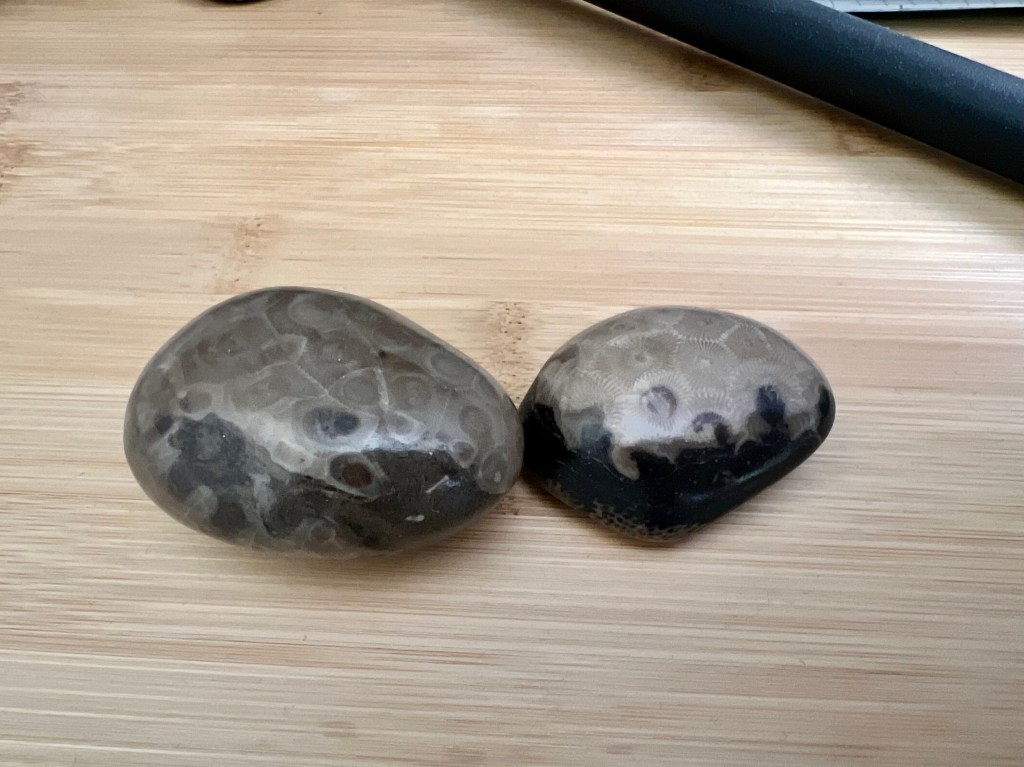
    For a newcomer like myself, I picked up a polished Petoskey stone and stared at its many intricate lines and what seemed like a 3-dimensional coral world under the polished surface.

    For Michiganders, especially people up north like my Wife’s family, the Petoskey Stone holds a special place and meaning for their identity as a person born and raised here. You can only find the stone here in MI and up north in and around the town that bears the same name.

    Each Petoskey Stone you pick up will be unique. One of a kind. So, when I found these two, pictured above, in a small shop in Petoskey MI, I was drawn to the way the stone has a blending of light and dark motion. What was happening when this stone was formed? I let my imagination run with a dramatic scene depicting the convergence of light and dark forces and how the world has always been made by this epic clash.

    Like these precious stones, the world is full of wonders and unique beings past and present. These creatures that were alive, living in coral communities millions of years ago, are telling their stories that each of us can now hold in the palm of our hands.

    It makes me ask: What will your story be? How will it be remembered?

    Want to go find a Petoskey Stone of your own?

    Here is an article to help you!

    Happy hunting!

    P.S. The cheat code I used to find mine was visiting this wonderful store with artisans and crafters that also make wonderful clay, wood, and jewelry, sometimes featuring the beautiful Petoskey Stone: Sturgeon River Pottery

  • I know for me beginning a fitness routine was work. yes, working out just seemed like so much work to get started.

    Visual of J sitting on the couch giving the peloton or rower the side eye…

    Then something magical happens. After I was in the workout, and after the workout, it felt so good and all of that “work” at the beginning to get started seemed small and worth it.

    Why is that?

    Why does something like working out seem like such a tall order to start?

    An activity that is so good for you physically and mentally should be just as appealing as pizza or beer right? (Side note) Check out this epic article by Thrillist… Nothing but Pizza things for 5 days!

    Well, apparently that’s not how this body was designed, and it’s through work our body and mind are sharpened and even our stress is better managed.

    While searching for the answer to this question, I came across this great article by Harvard Health.

    After 3 months of fitness, I can say that I do look forward to working out now. Reading why that is in this article was pretty interesting as well as all of the other benefits associated with fitness.

    Keep working!

    P.S. Pizza is magical despite the heartburn and lethargy.

  • Homemade Bread: Great Analogy for?

    Sometimes the best and most rewarding things in life are simple.

    Take for instance the homemade beer bread recipe courtesy of my wife Kath by way of her Mom and Grandma…

    This wonderful food contains 6 Ingredients;

    water, beer, butter, sugar yeast, flour…

    She follows a very simple process/recipe for 3 hours with on and off work.

    Ka-chow! She produces this:

    This same principle often applies to work.

    The other cool part is that she often made this with her grandma, now her mother, and she is teaching our daughter how to make it as well. Sometimes simple processes that lead to great outcomes stand the test of time as well.

    Are the processes your teams follow simple? Boiled down to their basic steps, repeatable? producing great results?

  • It’s a crisp fall morning, you can smell the coffee finishing its brew cycle, the computer chimes awake, and you click on your schedule to join the first meeting of the day. This meeting starts at 8:30 AM and as you sit at your desk the current time is 8:25 AM.

    ‘Great! I have time to grab my first cup of magic bean water!’

    You return to your desk by 8:29, click on the meeting link, and join the meeting with a fresh cup of joe and a smile…

    ‘Hey, did you get my email? There is something critical and I wanted to make sure you read it…

    Those are the first words you hear from your manager as the meeting starts. You are confused as you recall triaging all of the emails from the day before.

    ‘Umm, well, I don’t think so, let me check since I’m up to date on emails as of last night’

    You open the email as everyone in the meeting is now waiting on your response to this 1:1 exchange. The email in question came through at 8:28 AM right before this meeting started…

    (Start the dialogue around the email for 5-10 minutes in front of everyone)

    If you are a person that manages your workflow and day via email please don’t be this person. Most people work on an hourly email cadence. One of the best things about the current state of professional IT tools to date is a ‘workspace’ functionality where not only can you check in with your people via email, but there is also chat, which is immediate and lends itself better to this sort of check-in vs stalling a meeting, calling out the person, and then making sure they have read an email that came through 2 minutes before their first activity of the day begins. In addition, there are so many options for IT collaboration within these ‘workspaces’.

    I have used Google Workspaces and this solution is great for a team to email, but then collaborate via chat, and also all of the apps for process, policy, slide decks, and many other uses. Find the right sort of IT workspace for your group and lean in.

    As managers, let’s work to meet people where they are as people, but also with the power of the best tooling for the task at hand.